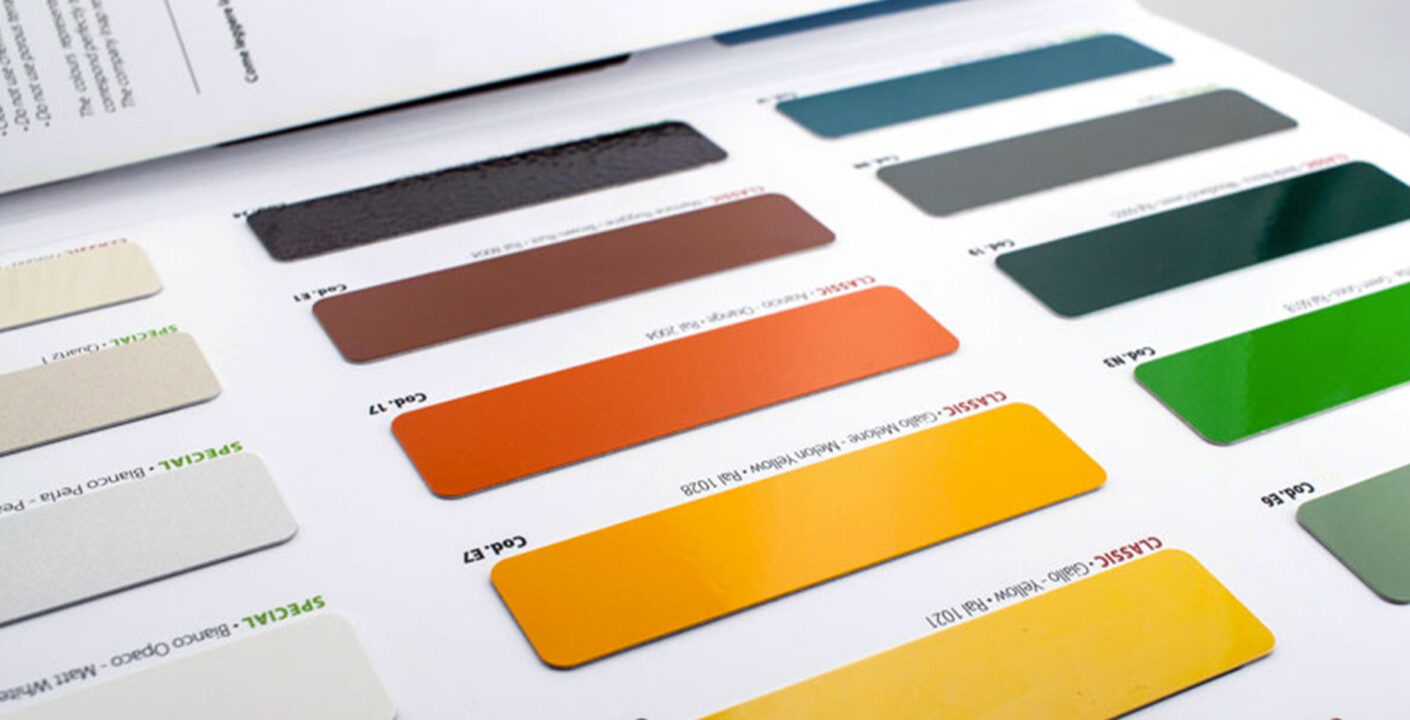
Physical colour samples are still considered indispensable by architects, designers, and clients—particularly for complex materials such as powder-coated metals—despite advances in display and printing technologies. They remain essential for sensory validation and for perceiving the full visual effect of the coated product.
This is closely linked to the way the human eye and touch perceive colours and materials, a process that even the most advanced digital representation can never truly replicate.
The science of perception and the indispensability of the physical sample
There are several scientific and psychophysical factors that support the crucial importance of physical samples:
Colour perception and metamerism
• Colour perception is a complex psychophysical process involving the interaction between light, the object, the eye, and the brain.
• A key phenomenon is metamerism, where two colours that appear identical under a given light source (e.g. a monitor) may look different under another (such as natural daylight or artificial ambient lighting). Powder-coated metals—especially those with special effects such as metallic, pearlescent, textured, or wood-effect finishes—are particularly subject to this phenomenon. Only a physical sample can be assessed under the real lighting conditions in which it will be used.
Material effects and viewing angle
• Surface structure (glossy, matte, rough) and any metallic or iridescent effect dramatically change the perception of colour.
• Observing a coated metal surface from different angles can make colours appear lighter or darker due to the reflectance of metallic particles. Digital screens cannot accurately or consistently simulate this dynamic variation in gloss and colour shift.
The role of touch and materiality
• The final decision on a material is based not only on sight. Touch provides essential information about texture, perceived quality, and the “feel” of the material—fundamental elements in design and architecture.
• A physical sample allows you to perceive roughness, smoothness, and coating thickness, aspects that a photograph or 3D rendering cannot convey.
The limits of digital reproduction
Although digital tools such as spectrophotometers are essential for objective measurement, standardisation, and colour quality control (providing numerical data for formulation), they do not replace final human evaluation:
- Calibration and subjectivity: colour perception on a screen depends on monitor calibration, graphics hardware, and the observer’s subjectivity (which may vary with age, fatigue, and colour memory).
- Lack of texture data: standard digital measurements focus mainly on spectral colour characteristics, often overlooking the dynamic interaction with texture and surface gloss.
In conclusion, physical colour samples—such as those produced by MDM for powder-coated aluminium—remain indispensable for:
• Accurate evaluation: verifying colour and effect under real lighting conditions.
• Complex decisions: integrating visual perception (colour, gloss, metamerism) with tactile perception (texture, materiality).
• Unambiguous communication: ensuring that clients, designers, suppliers, and manufacturers share an objective, non-ambiguous reference—extremely valuable should any dispute arise regarding colour selection.